
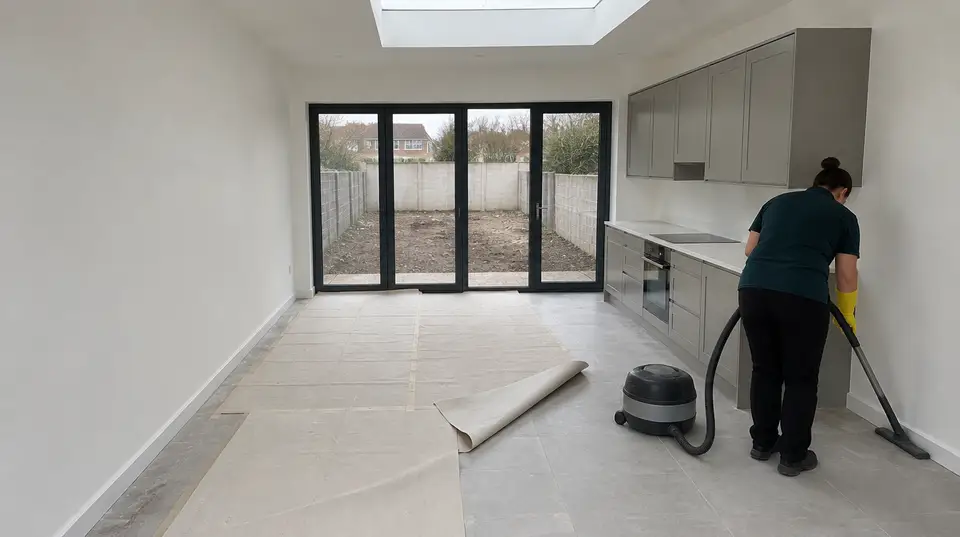
HEPA-Filtered After Builders Cleaning in Dublin
The final clean after a renovation, extension or new build: builders dust, paint splashes and stickers removed, priced by property size.
- From €190
- All County Dublin
- Own products
- Insured team
Dublin Cleaners is a Citywest-based cleaning company working across County Dublin and in Bray, Maynooth and Naas. After builders cleaning in Dublin is the job that turns a finished building site back into a home. We remove the fine builders dust, paint and plaster splashes, stickers and protective film that a renovation, extension or new build leaves behind, using HEPA vacuums and damp wiping rather than brushes. Last updated: 14 November 2026.
After Builders Cleaning prices in Dublin
Fixed prices by bedroom. Final prices: no VAT is added on top.
from €190
| 1-bed apartment | from €190 |
|---|---|
| 2-bed apartment or house | from €260 |
| 3-bed house | from €340 |
| 4-bed house | from €420 |
Add-ons
- Carpet cleaning, per roomfrom €55
- Three carpeted roomsfrom €145
- Exterior windows, 2 to 3 bed housefrom €60
- Sofa cleaning, 3-seatfrom €95
Cleaning services carry the reduced VAT rate of 13.5% in Ireland, and our prices already include any VAT due.
Published prices from other Dublin companies, including per m² rates, are compared in our guide to after builders cleaning cost.
What changes the price
- Size: the price table is built on bedrooms, with en-suites and extensions adding time.
- Dust level: a whole-house renovation leaves far more dust than a single new bathroom.
- Residue: heavy paint, plaster or grout haze on glass and tiles takes longer than a light film.
- Stage: a final sparkle clean is priced in the table; an interim builders clean is quoted separately.
What is included
- HEPA vacuuming of every surface, top to bottom
- Damp wiping of walls, doors, frames and skirting
- Paint and plaster splashes removed from glass and frames
- Stickers, labels and protective film taken off
- Inside every press, drawer and wardrobe
- Window frames, sills and runner tracks
- Bathrooms, tiles and grout haze cleaned
- Hard floors vacuumed and mopped, carpets vacuumed
Not included
- Removing rubble, offcuts, skips or builders' waste
- Outside glass (window cleaning add-on)
- Paint touch-ups, regrouting or resealing
- Cleaning during live work, while trades are still cutting or sanding
- Asbestos, or any dust from suspected asbestos materials
What an after builders clean covers, room by room
An after builders clean removes the fine dust and residue that building work leaves on every surface, inside and out of every cupboard. It is done after the trades have finished. It goes further than a deep clean, because the dust is finer and the residue is paint, plaster and glue.
Every room is worked from the ceiling down. Dust is lifted first, surfaces are damp wiped second, and residue is removed third, so nothing is wiped twice.
- Ceilings, coving and cobwebs
- Tops of doors, frames and architraves
- Paint spots on glass, tiles and floors
- Plaster splashes on frames and sockets
- Internal glass cleaned streak-free
- Frames and handles wiped
- Cupboards, drawers and hinges inside
- Worktops, splashback and sink
- Hard floors HEPA vacuumed, then mopped
- Edges and corners done by hand
Builders dust, top to bottom
Plaster and sanding dust is so fine that it sits on every ledge, including the tops of doors and the inside of new presses. A HEPA vacuum with a soft brush head lifts it without throwing it back into the air. Each surface is then damp wiped with a well-wrung microfibre cloth, which catches what the vacuum leaves.
Radiators are vacuumed between the fins, and sockets, switches and light fittings are wiped with the power off where possible. Skirting boards are hand-wiped, as dust settles on the top edge and in the paint.
Paint, plaster splashes and stickers
Paint and plaster splashes are the part people struggle with most. Fresh splashes on uPVC, tiles and sanitaryware are softened with warm water and lifted with a plastic scraper. On plain glass, cleaners commonly use a sharp blade held flat. Coated glass, brushed steel and high-gloss doors should get no blade, only a solvent the maker allows.
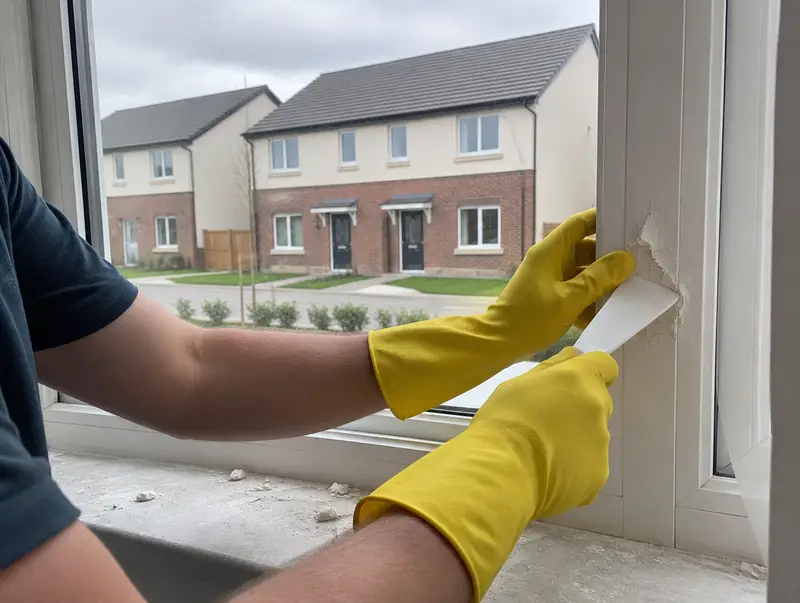
Labels on baths, toilets, windows and appliances are peeled, and a citrus-based remover usually lifts the glue. The blue or clear protective film on new window frames comes off too, as it bakes on in sunlight and gets harder to remove over time.
Windows, frames, sills and tracks
New window frames trap plaster in the hinges, the runner tracks and the small drainage slots at the bottom. Those are vacuumed out before wiping, as water turns plaster dust into paste. Bifold and patio door tracks get the same treatment, because grit in the track wears the rollers.
Internal glass is cleaned on every window. Exterior glass can be added from our window cleaning price list.
Kitchens and bathrooms
A new kitchen arrives full of sawdust in the hinges and drawer runners. Every cupboard and drawer is vacuumed and wiped inside. Appliances are cleaned inside and out, including the dishwasher filter and the washing machine drawer, which often hold dust from installation.
In bathrooms, tiling leaves a thin grout haze that dulls the surface once it dries. It is removed with a tile-safe haze remover, then the tiles are rinsed. Taps, shower screens and toilets are cleaned, and stickers come off the sanitaryware.
Floors and carpets
Floors are always cleaned last. Hard floors are vacuumed with the HEPA unit first, then mopped with a cleaner suited to the finish. Oiled wood and natural stone need a pH-neutral product, as most makers' care guides say. New carpets are vacuumed slowly in two directions to lift plaster dust from the pile. Where dust has been walked in, carpet cleaning with hot water extraction can be added.
Builders clean vs sparkle clean: which stage you need
A builders clean is the rough first clean when the trades finish: rubble out, floors swept, large dust removed. A sparkle clean is the final, detailed clean that makes the property ready to live in or hand over. Most homeowners need the sparkle clean, and our price table is built on it.
On larger projects, the builder's own crew usually does the builders clean, and their contract may say so. Check before you book, because a sparkle clean assumes the rubble and offcuts are already gone.
Some jobs need an interim clean between the two. If new floors are going down after the plasterers, a dust clean before the flooring fitter arrives keeps grit from being sealed under the finish. We quote interim cleans separately, as the work depends on how far the job has got.
Is builders dust dangerous? What the HSA says
Builders dust from concrete, stone, brick and some boards can contain crystalline silica. The Health and Safety Authority sets the exposure limit for respirable crystalline silica at 0.1 mg/m³, averaged over 8 hours. It describes that fraction of the dust as "invisibly fine". It can cause silicosis, which the HSA calls irreversible.
0.1 mg/m³
HSA exposure limit for respirable crystalline silica, 8-hour average
HSA silica dust information sheet
8 hours
period the limit is averaged over
HSA
FFP3
disposable respirator class the HSA names for silica dust
HSA
That limit is written for workers on site, not for a home after the trades have left. It still points to the right method. The HSA recommends wet methods for dust removal, so damp wiping beats dry dusting. Dry sweeping fine dust is a mistake, because a brush puts it straight back in the air.
HEPA vacuums trap the fine particles that an ordinary vacuum blows out through its exhaust. Masks matter for anyone going into dusty rooms before the clean. If you live in the house during the work, keep doors to finished rooms closed. Stay out of rooms while sanding or cutting is going on.
When to book: paint, floor finishes and snagging
Book the after builders clean after the last trade leaves, once paint is dry and floor finishes have cured. Cleaning too early means the next trade brings fresh dust. Cleaning before a floor lacquer or oil has cured can mark the finish, so check the maker's cure time first.
A typical order runs like this: plastering, first-fix and second-fix trades, painting, then floor finishes, then the sparkle clean, then furniture. If a painter is coming back for touch-ups after the snag list, put the clean after that visit.
Fine dust keeps drifting down from ceilings and light fittings after sanding stops, and how long the dust takes to settle depends on the job. Opening windows for a day or two before the clean helps. A quick dust and mop a week after you move in catches the last of it.
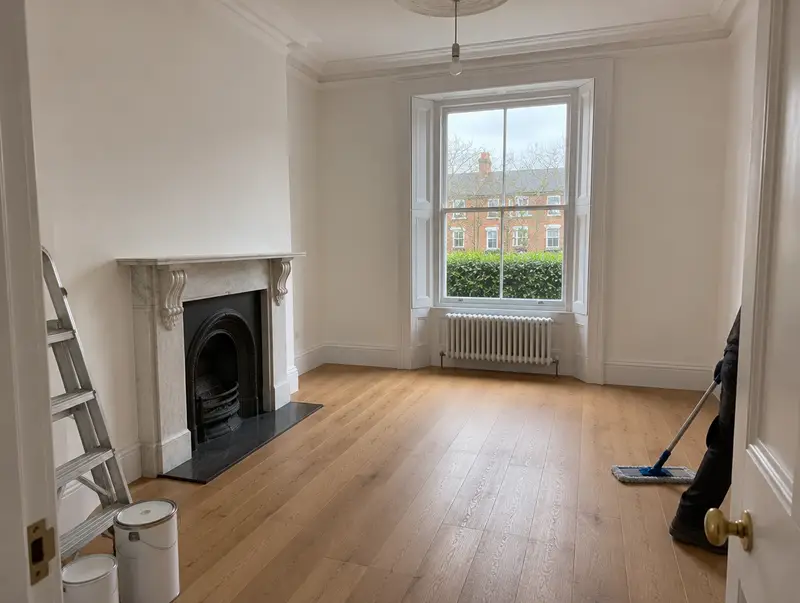
Post renovation, extension and new build cleaning
Post renovation cleaning, extension cleans and new build cleaning follow the same method but start from different places. A renovation spreads dust through rooms that were never touched. An extension concentrates it in one area. A new build arrives with dust inside every press, stickers everywhere and film on the windows.
Renovations and extensions
- Untouched rooms dusted too
- Soft furnishings vacuumed
- Stairs, banisters and hallway
- Dust sheets lifted and floors cleaned under
Dust travels under doors and up stairs, even with sheeting up. A renovation clean covers the rooms where nobody worked, because their shelves, curtains and sofas collect the drift. Bedrooms are often the worst, as doors were left open for the trades.
New builds and snagging
- Handover clean before move-in
- Stickers off sanitaryware and glass
- Protective film off frames
- Clean after snag repairs are done
New homes in Adamstown, Clonburris and the other large Dublin schemes are often handed over with a light builder's clean only. A full clean before your furniture arrives is far easier than one around boxes. Book it after the builder has fixed your snag list, as repairs bring fresh dust.
Equipment, products and insurance
Our team brings its own HEPA vacuums, microfibre cloths, scrapers, ladders and cleaning products, so nothing needs to be left on site. Dublin Cleaners carries public liability insurance for work in your home, which matters when new floors, fitted kitchens and fresh paint are all in the same room.
New finishes need matching products: pH-neutral cleaners for stone and oiled wood, tile-safe haze removers for grout and gentle glue removers for stickers. Tell us at booking which floors and worktops were fitted. Open the windows while the clean is under way so any fumes clear, and keep children and pets out until the floors are dry.
How the options compare
| Doing it yourself | Builder's sweep-out | Dublin Cleaners | |
|---|---|---|---|
| Fine dust removed | Household vacuum, dust returns | Swept, dust airborne | HEPA vacuum and damp wipe |
| Paint splashes on glass | Risk of scratching | Left | Removed with a method suited to each surface |
| Stickers and protective film | Slow | Left | Removed, glue residue cleaned |
| Inside cupboards and frames | If you have time | Not included | Included |
| Products and equipment | Buy them | Not applicable | We bring them |
| Price known in advance | Your weekend | In the build price | Fixed by property size |
Book your after builders clean
Send photos of each room and tell us what work was done. We confirm a fixed price by property size before the day.
After Builders Cleaning: questions
How much is after builders cleaning in Dublin?
After builders cleaning with Dublin Cleaners costs from €190 for a 1-bed apartment, €260 for a 2-bed and €340 for a 3-bed house. A 4-bed house starts at €420. There is no VAT to add to those figures. Heavy paint residue or grout haze adds time, so we confirm the price first, with a site visit if needed.
How long should I wait after the builders leave?
Book the clean once the last trade has finished, paint is dry and any floor finish has cured to the maker's instructions. Fine dust keeps settling for a while after sanding, so a day or two with windows open helps. Cleaning while trades are still cutting means the dust lands again by evening.
Can you remove paint from new windows and tiles?
Yes, in most cases. Fresh water-based paint lifts from uPVC with a plastic scraper and warm water. On plain glass, the usual trade method is a sharp blade held flat, which does not scratch it. Coated or self-cleaning glass should get no blade at all. Dried grout haze on tiles comes off with a tile-safe haze remover.
Do you clean new builds before we move in?
Yes. New homes are handed over with dust in every cupboard, stickers on sanitaryware and film on windows. We clean the whole property before your furniture arrives, including inside presses and wardrobes. If your snag list leads to more work by the builder, book the clean for after those repairs are done.
How do I book?
Call 01 230 8646 or send the quote form with the service and your area. We reply with a price, usually by phone, and confirm the day and access arrangements before the team arrives.
Related services
A top-to-bottom once-off clean for homes that need more than the weekly tidy, from behind appliances to the tops of doors.
From €150 / 1-bed homeInside and outside glass, frames and sills for houses, apartments and shopfronts.
From €60 / 2 to 3 bed house, outsideHot water extraction for carpets and rugs, priced per room, with stairs and landings quoted separately.
From €55 / room