
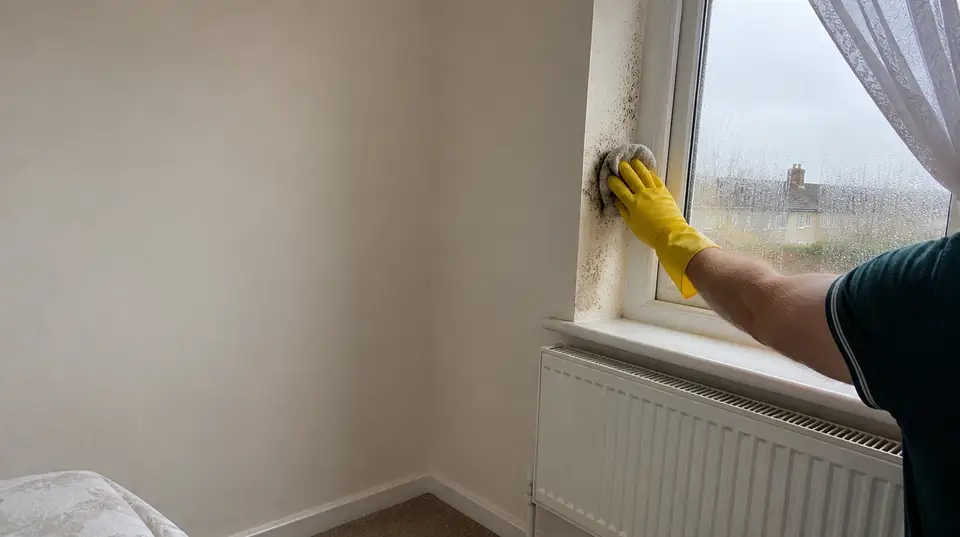
Surface Mould Removal in Dublin
Black mould cleaned from walls, ceilings, window reveals, silicone and grout, with clear guidance on when the damp needs a specialist.
- From €95
- All County Dublin
- Own products
- Insured team
Dublin Cleaners is a cleaning company based in Citywest, Dublin 24, taking bookings across County Dublin plus Bray, Maynooth and Naas. Our mould removal in Dublin is a cleaning service for the surface growth you can see: black spots on walls and ceilings, window reveals, silicone and grout. Cleaning removes the growth, and the signs below help you judge whether the cause is condensation you can manage or damp that needs a specialist or your landlord. Last updated: 14 November 2026.
Mould Cleaning prices in Dublin
Fixed prices per item or room. Final prices: no VAT is added on top.
from €95
| One room, walls, ceiling and window | from €95 |
|---|---|
| Whole bathroom, incl. silicone and grout | from €120 |
Add-ons
- Deep clean, 1-bedfrom €150
- End of tenancy clean, 1-bedfrom €165
- Carpet cleaning, per roomfrom €55
- Mattress cleaningfrom €60
Cleaning services carry the reduced VAT rate of 13.5% in Ireland, and our prices already include any VAT due.
What changes the price
- Area: our prices cover patches of surface growth, not whole walls of mould.
- Surface: gloss paint and tiles clean faster than matt paint or textured ceilings.
- Height: high ceilings and stairwell walls need more set-up time.
- Rooms: a bedroom, a bathroom and a kitchen are priced as separate areas.
What is included
- Black mould cleaned from painted walls and corners
- Bathroom and bedroom ceilings
- Window reveals, sills, frames and rubber seals
- Silicone along baths, showers and sinks
- Grout lines scrubbed
- Loose spores lifted with a HEPA vacuum
- Surfaces damp wiped with a fungicidal cleaner
- Dust cleared from trickle vent slots
Not included
- Damp surveys, moisture readings or air testing
- Mould inside walls, attics, basements or under floors
- Cutting out silicone, regrouting or repainting
- Mould from sewage or flood water
- Fixing leaks, vents or extractor fans
What our mould cleaning covers
Our mould cleaning covers surface growth on hard and painted surfaces: walls, ceilings, window reveals, frames, silicone and grout. It suits the black spotting that condensation leaves in bathrooms, bedrooms and behind furniture. It does not cover mould inside walls, under floors or in attics, which needs a damp specialist.
- Bedroom corners on outside walls
- Behind wardrobes and headboards
- Reveals and sills wiped
- uPVC frames and hinges
- Bath and shower tray silicone
- Sink and worktop seals
Walls, ceilings and corners
Mould grows where warm, wet air meets a cold surface, so outside corners and the wall behind a wardrobe are the usual spots. Loose growth is lifted with a HEPA vacuum, then the surface is damp wiped with a fungicidal cleaner. Brushing should be avoided, as it throws spores into the room.
Matt paint often holds a grey shadow after cleaning. That stain is in the paint, and a coat of mould-resistant paint is the fix.
Window reveals, sills and frames
Condensation runs down the glass every winter morning and pools on the sill. The reveal, frame, hinges and rubber seal are cleaned, and dust is cleared from the trickle vent slots so they can do their job. Black marks deep inside a perished seal may not lift fully.
Silicone, grout and shower seals
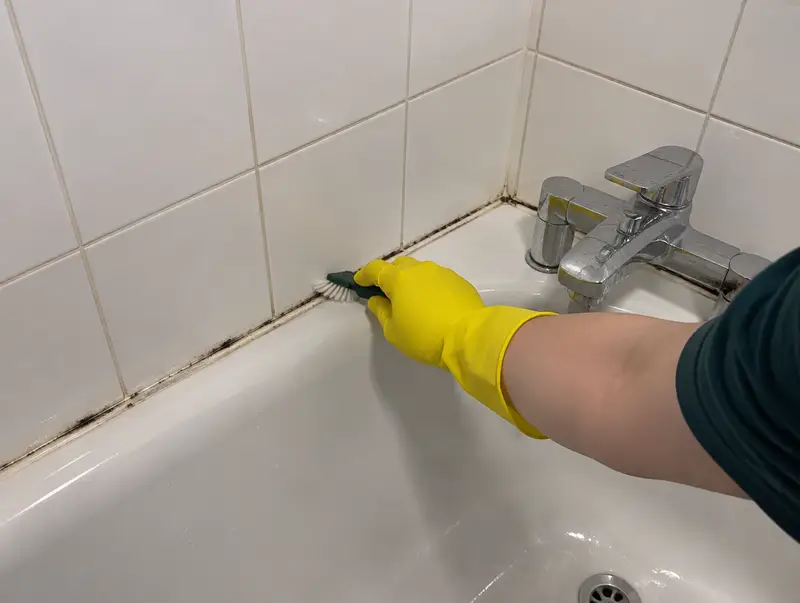
Silicone and grout are where most bathroom mould starts, because they stay wet longest. Grout is scrubbed and rinsed, and silicone is cleaned along its full length. When the growth has rooted under the surface of the sealant, cleaning only lightens it. Cutting the silicone out and resealing is then the real fix, and that is a job for a handyman or tiler.
Surface mould or a damp problem? Where cleaning stops
Cleaning suits patches of surface mould fed by condensation. State Claims Agency guidance on gov.ie says trained cleaning staff can handle areas under 3 m². Larger areas need specialist remediation. Rising damp, penetrating damp, leaks and mould inside walls are specialist work.
3 m²
mould area above which specialist remediation is advised
State Claims Agency, gov.ie
15 min
overrun SEAI advises on a wet-room extract fan with no window
SEAI
€95
our price to clean surface mould in one room
Dublin Cleaners price list
Call a damp specialist if the mould sits in a tide mark low on the wall, appears after rain, or covers more than a few patches. The same goes for a musty smell with no visible growth. A specialist can take moisture readings and find the source, which no cleaner can.
We do not promise mould will not return, because nobody can while the moisture is still there. Look for a likely cause too, such as a dead extractor fan or a stained ceiling under a bathroom.
Condensation and ventilation: why mould comes back
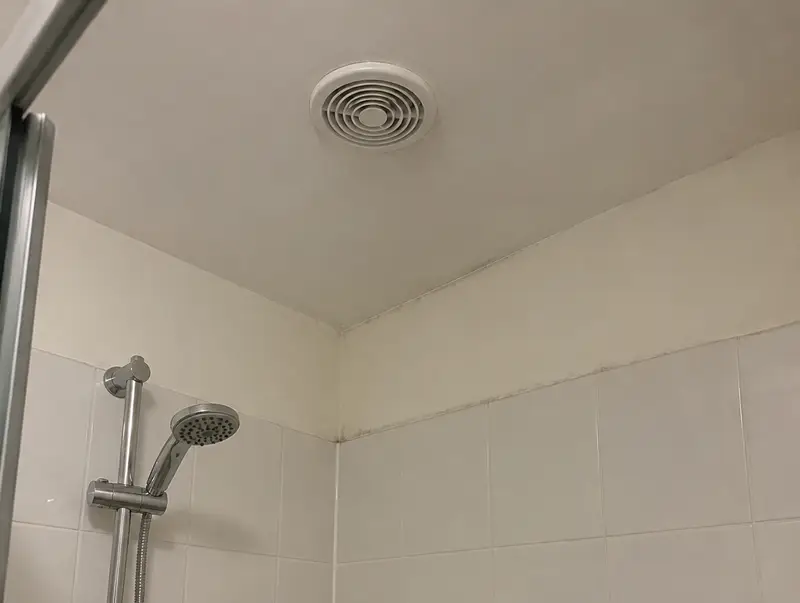
Mould usually comes back because water vapour has nowhere to go. SEAI names cooking, laundry and showers among the sources, and says every wet room should have a mechanical extract fan. Where a wet room has no window or background vent, the fan should run on for 15 minutes.
Run the extractor while showering and cooking, and leave it on afterwards. Keep trickle vents open, even in winter. Dry clothes outside or in a vented dryer where you can, and keep furniture a little away from outside walls.
A dehumidifier helps in a bad week, but it treats the symptom. Older Dublin houses suffer most from winter condensation, when windows stay shut and washing dries indoors.
Renting? What your landlord must fix
Rented homes in Ireland must meet minimum standards. The Residential Tenancies Board says the structure must not have damp, and the home must have proper heating and ventilation that tenants can control. The 2019 regulations also require adequate ventilation to remove water vapour from every kitchen and bathroom.
If those standards are not met, the RTB advises telling your landlord in writing and allowing reasonable time to fix it. If nothing happens, you can apply to the RTB for dispute resolution or ask your local authority to inspect. Local authorities enforce the standards and can issue an improvement notice.
Cleaning first and photographing the result helps both sides see whether mould returns. The rules on mould in a rented house set out who is responsible for what.
Health, bleach and safety
The HSE lists mould among common allergens, saying it releases small particles into the air that you can breathe in. Allergic reactions can worsen asthma or eczema. Anyone with asthma or a breathing condition should stay out of the room while mould is cleaned, and until it has aired.
Bleach is not a cure. The Health and Safety Authority warns that bleach must not meet ammonia, toilet cleaners or drain cleaners, as a harmful gas can form. State Claims Agency guidance adds that biocides alone do not solve mould problems, since dead mould can still trigger allergies.
Mould left by sewage or flood water is a different job, with infection risks, and needs a specialist. Dublin Cleaners carries public liability insurance, and our team brings its own products and equipment.
Moving out or moving in?
Mould is one of the first things a letting agent spots at a check-out inspection, and one of the first things a new tenant sees. A mould clean can be booked on its own or with a full end of tenancy clean. That way walls, reveals and seals are done on the same visit.
If you are leaving a rented home, the end of tenancy clean covers the rest of the property to inventory standard. Mention the mould when you book, so the time is built in.
How the options compare
| Doing it yourself | Bleach spray | Dublin Cleaners | |
|---|---|---|---|
| Spores kept out of the air | Brushing spreads them | Spray can disturb them | HEPA vacuum, then damp wipe |
| Safe product choice | Risk of mixing | Never mix with other cleaners | Fungicidal cleaner, no mixing |
| Silicone and grout lines | Hard to reach | Bleaches the colour only | Scrubbed and rinsed |
| Products and equipment | You buy them | Bought by you | We bring them |
| Price known in advance | Your time | A few euro | From €95 a room |
| Public liability cover | Not applicable | Not applicable | Yes |
Book your mould clean
Send photos of each affected patch and tell us the rooms. We confirm a fixed price, or tell you straight if it needs a damp specialist.
Mould Cleaning: questions
How much does mould removal cost in Dublin?
Mould removal with Dublin Cleaners costs from €95 for one room and €120 for a whole bathroom, including silicone and grout. Those are final prices, VAT included. They cover surface growth on walls, ceilings, reveals and seals. Large areas or mould inside walls need a damp specialist instead.
Will the mould come back after cleaning?
It can, if the moisture behind it stays. Cleaning removes the growth you can see, but condensation, a leak or a blocked vent will feed new spots. State Claims Agency guidance says mould is highly likely to recur if the moisture source stays. Fix the source too.
Is black mould cleaning safe with children or asthma in the house?
Keep children and anyone with asthma out of the room during the clean and until it has aired. The HSE lists mould as an allergen that releases particles you can breathe in, and allergic reactions can worsen asthma. A HEPA vacuum on loose spores before wiping keeps less in the air.
Should my landlord pay for mould removal?
If the cause is damp in the building, a broken extractor fan or poor ventilation, it falls under the landlord's duty to meet minimum standards. Tell the landlord in writing first. If condensation from daily living is the cause, the landlord still has to provide working ventilation, and you need to use it.
How do I book?
Call 01 230 8646 or send the quote form with the service and your area. We reply with a price, usually by phone, and confirm the day and access arrangements before the team arrives.
Related services
A top-to-bottom once-off clean for homes that need more than the weekly tidy, from behind appliances to the tops of doors.
From €150 / 1-bed homeA full move-out clean to the standard letting agents check at handover, with the oven, cupboards and appliances cleaned inside.
From €165 / 1-bed apartmentWeekly or fortnightly domestic cleaning by the hour, with products and equipment brought by the team.
From €28 / hour